
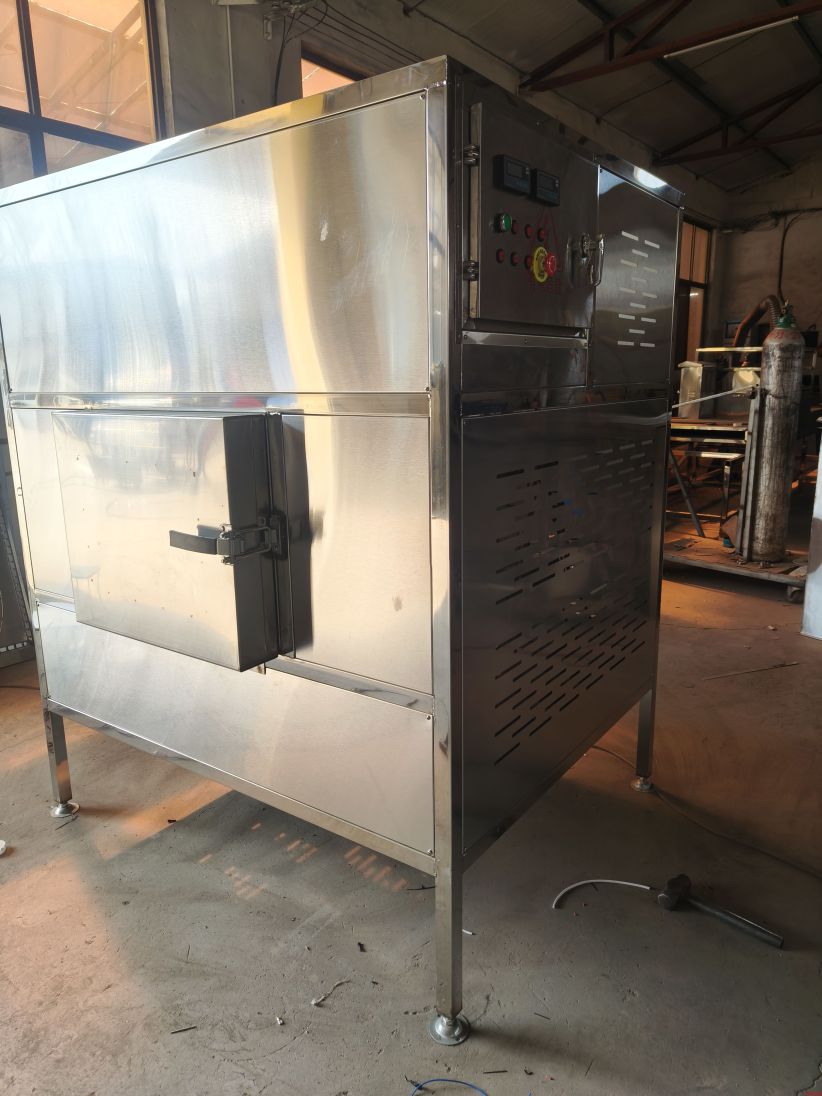
Microwave high-temperature sintering furnace
- Ruisen En
- Shijiazhuang
- stainless steel
Compared with traditional heating methods, microwave sintering has internal heating characteristics, that is, microwaves can penetrate the interior of the material, causing the center temperature to reach the ignition point and trigger combustion synthesis. The sintering wave propagates from the inside out, achieving uniform heating of the sample.
Product details

The working principle and technical characteristics of microwave high-temperature sintering furnace
Microwave high-temperature sintering furnace is an advanced equipment that uses microwave radiation to achieve high-temperature sintering of materials, and its core principle is based on the heating effect of microwave media. When the material is in a microwave electric field, polar and non-polar molecules will polarize and vibrate at high speed due to the electric field (such as 245 million vibrations per second at a frequency of 2450MHz), converting electromagnetic energy into thermal energy through molecular friction, making the material itself a heating element. Compared with traditional heating methods, microwave sintering has internal heating characteristics, that is, microwaves can penetrate the interior of the material, causing the center temperature to reach the ignition point and trigger combustion synthesis. The sintering wave propagates from the inside out, achieving uniform heating of the sample.
The technical characteristics of the equipment include:
- Efficient and energy-saving: The heating speed is fast (such as graphite can rise from room temperature to 1000 ℃ within 20 minutes), saving 90% of heating time compared to traditional muffle furnaces.
- Accurate temperature control: using infrared temperature measurement or thermocouple, the temperature control accuracy reaches; 1 ℃, supports preset multiple process curves and real-time data monitoring.
- Safe and reliable: The microwave leakage is low (0.05mW/cm2, lower than the average leakage value of mobile phones), and it has multiple alarm functions such as the furnace door not being tightly closed, overheating, and low water flow.
- Controllable atmosphere: It can be filled with protective atmospheres such as air and inert gases to meet the requirements of oxidation or reduction reactions.
Core parameters and classification of microwave high-temperature sintering furnace
Main technical parameters
The key parameter differences of different models of equipment are shown in the following table:
Parameter category; Typical Range; Example model (HT-HM1700C-M)
Microwave power; 0.5-16kW (continuously adjustable); 0.5-2.9kW
Maximum temperature; 1200-1750℃ 1700℃
Heating space; 1.2L (110× 100× 110mm) to custom size; 150× 105× 70mm
Control method; PLC+touch screen, supporting manual/constant temperature/automatic control modes; 7-inch Siemens touch screen+Mitsubishi PLC
Cooling system; Water cooling (flow rate≥ 0.5m³); /h, Water temperature: 35 ℃; Double layer water-cooled furnace body, magnetron water-cooled
Equipment classification
- By purpose: laboratory type, industrial production type (supports customization, used for batch sintering of ceramics and electronic devices).
- According to atmosphere: air atmosphere furnace, vacuum atmosphere furnace, inert gas protection furnace.
- By structure: box type, vertical rotating continuous type (suitable for continuous production).
Application Fields and Typical Scenarios
Microwave high-temperature sintering furnaces are widely used in fields such as materials science, electronic engineering, and chemical engineering, with specific scenarios including:
1. Ceramic materials: sintered structural ceramics such as alumina, silicon nitride, and silicon carbide, as well as electronic ceramic devices such as PZT piezoelectric ceramics and varistors.
2. Powder metallurgy: sintering and heat treatment of hard/soft magnetic materials and metal magnets.
3. New energy materials: high-temperature synthesis of lithium battery cathode materials (lithium cobalt oxide, lithium iron phosphate) and rare earth luminescent materials.
four. Laboratory research: Used by universities and research institutions for high-temperature synthesis, ashing, melting and other experiments of materials, supporting the exploration of small-scale sample processes.
Comparative advantages with traditional sintering technology
Compared to traditional equipment such as resistance furnaces and muffle furnaces, the advantages of microwave sintering furnaces are reflected in:
- Heating uniformity: avoid the problems caused by traditional external heating; Surface overheating, no internal reaction; Problem.
- Efficiency and Cost: The heating rate is increased by 5-10 times, and energy consumption is reduced by 30% -50%.
- Material performance optimization: reduce grain growth, improve product density and mechanical properties (such as increasing ceramic fracture toughness by 20% -30%).
- Environmental Protection and Safety: No exhaust emissions, microwave leakage far below the national standard, and a more friendly operating environment.
Precautions for selection and use
Key points for purchasing
- Clear requirements: Select the temperature range based on material characteristics such as melting point and thermal conductivity (1200 ℃ for general ceramics, 1700 ℃ for high melting point materials such as zirconia).
- Customization requirements: Industrial grade equipment supports customization of heating space, power, and atmosphere systems, and process details need to be communicated with the manufacturer.
- Brand and after-sales service: Priority should be given to suppliers with industrial grade microwave sources (such as Changyi and Xianou) and comprehensive services.
Precautions for use
- Material compatibility: Non polar materials (such as certain plastics) require the addition of absorbing media for auxiliary heating.
- Cooling system maintenance: Ensure stable cooling water flow and temperature to avoid damage to the magnetron due to overheating.
- Safe operation: Strictly follow the furnace door interlock mechanism, and wear insulated gloves when operating at high temperatures.
Market Status and Development Trends
The current market is dominated by customized equipment, with laboratory small furnaces (10L) and industrial large furnaces (customized sizes) coexisting. The direction of technological development includes:
- Intelligence: Integrating AI algorithms to optimize process parameters and achieve fully automated production.
- Multi functional integration: integrating multiple processes such as drying, sintering, quenching, etc., with functions of sintering, ashing, and roasting.
- Breakthrough in Higher Temperature: Develop ultra-high temperature models above 1800 ℃ to expand the application of refractory metals and ceramics.
Tags:
Microwave High Temperature OvenContinuous tunnel high-temperature sintering furnaHigh temperature push plate kilnRoller kiln | Microwave roller kilnMicrowave high temperature furnace | Muffle furnacHigh temperature tower vertical kilnHigh temperature mesh belt sintering kilnHigh-temperature shuttle bell kilnHigh-temperature quartz tube furnaceHigh-temperature microwave rotary kilnHigh-temperature crucible and saggerAir source heat pump drying and dehumidifying machHigh-temperature insulation refractory material