
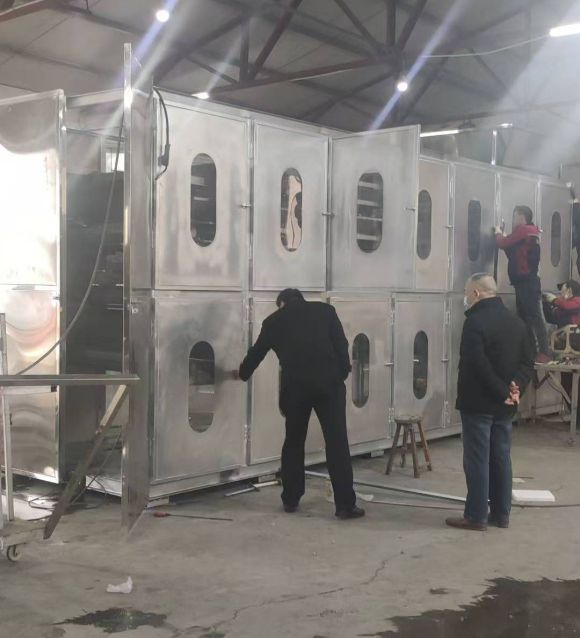
Mesh belt dryer | Stainless steel mesh belt dryer | Continuous mesh belt furnace | Mesh belt tunnel furnace
The heat pump dryer operates based on the reverse Carnot cycle principle, absorbing low-temperature heat from the environment and transferring it to the drying room to achieve heating. Its working process is opposite to that of a refrigeration machine (the former increases the temperature, while the latter decreases the temperature).
Product details

The working principle and core components of a heat pump dryer
Mesh belt dryer | Stainless steel mesh belt dryer | Continuous mesh belt furnace | Mesh belt tunnel furnace
The heat pump dryer operates based on the reverse Carnot cycle principle, absorbing low-temperature heat from the environment and transferring it to the drying room to achieve heating. Its working process is opposite to that of a refrigeration machine (the former increases the temperature, while the latter decreases the temperature). The core components include four key parts:
- Fin type evaporator (external unit): absorbs heat from the outdoor environment, and the refrigerant evaporates into a gaseous state here, with a temperature as low as -20~-30 ℃.
- Compressor: It boosts and heats up the gaseous refrigerant to a temperature of up to 100 ℃, providing power for heat transfer.
- Fin condenser (internal unit): High temperature refrigerant releases heat here to heat the air in the drying room, while cooling itself into a liquid state.
- Expansion valve: Adjust the flow rate of refrigerant to achieve throttling and pressure reduction of liquid refrigerant, preparing for the next cycle.
Thermal cycle process: refrigerant passes through; Evaporation→ Compression→ Condensation→ Throttle→ Re evaporation; The cycle converts environmental heat (QA) and compressor power consumption (QB) into drying room heat (QC=QA+QB), resulting in much higher thermal efficiency than traditional electric heating equipment.
Technical advantages and characteristics of heat pump dryer
Core advantages
- Efficient and energy-saving: The thermal efficiency (QC/QB) is much higher than 1, saving 30% -50% energy compared to traditional drying equipment. The SMER value (unit energy consumption for water removal) reaches 1.0-4.0kg/kWh, while traditional equipment only has 0.2-0.6kg/kWh。
- Low temperature drying and quality assurance: The drying temperature can be controlled between 20-80 ℃, suitable for heat sensitive materials (such as food and medicinal materials), to avoid high temperature damaging nutrients or causing material deformation.
- Environmentally friendly: The dry medium is enclosed and circulated, with no dust or exhaust emissions, reducing pollutants such as CO ₂ and meeting energy-saving and emission reduction requirements.
- Multi functional scalability: Some models can switch cooling modes to achieve low-temperature processing (such as quick freezing, refrigeration) or heating and heating, improving equipment utilization.
Other key features
- Intelligent control: supports precise temperature and humidity control, adapts to different material drying processes (such as moisture control and cracking prevention for wood, temperature control and flavor preservation for food).
- Wide material adaptability: It can handle food, medicinal herbs, wood, industrial products, etc., especially suitable for materials that are prone to oxidation and contain volatile components (such as spices and essential oils).
- Low operating costs: No need for fuel storage or flue, electricity costs are only 1/3-1/4 of electric heating equipment, and maintenance is simple.
Application fields and scenarios of heat pump dryer
Main application industries
- Food processing: drying fruits and vegetables, meat products, seafood, dried fruits, Rolls of dried bean milk creams, etc., such as AD black tremella, melon seeds, casing dehydration.
- Agricultural and sideline products and medicinal herbs: used for drying shiitake mushrooms, goji berries, traditional Chinese medicinal herbs, and tobacco leaves, retaining effective ingredients and appearance.
- Industrial manufacturing: drying of wood, leather, hardware products, chemical raw materials, as well as constant temperature electroplating solution and industrial hot water supply (such as slaughterhouses and hotels).
- Service industry: Batch drying of bedding in hotels and guesthouses, replacing traditional drying or electric dryers.
Typical scenario example
- Drying of traditional Chinese medicinal materials: Low temperature circulation of 40-60 ℃ is adopted to avoid decomposition of active ingredients, and the drying uniformity reaches over 95% [2].
- Wood treatment: By controlling temperature and dehumidification, cracking and deformation are reduced, and the drying cycle is shortened by 50% compared to natural drying.
- Industrial hot water: meets the constant temperature requirements of electroplating plants at 30-80 ℃, or provides 24-hour high-temperature hot water for star rated hotels.
Comparison with traditional drying equipment
Indicator Heat pump dryer; Electric heating dryer; Fuel/gas dryer
Thermal efficiency; 300%-500%(QC=QA+QB) &100% (only consumes electricity and converts heat); 60% -80% (including combustion loss)
Environmental friendliness; Zero emissions, no pollutants; Indirect emissions (thermal power pollution); High emissions (CO ₂ NOx)
Applicable scenarios; Small and medium-sized, multi variety batch production; Small batch, temporary use; Large scale, high-temperature resistant materials
Operating costs; Low (mainly electricity); High (expensive electricity bills); Medium to high (impact of fuel price fluctuations)
Heat pump dryers have significant advantages in energy conservation, environmental protection, and material adaptability, especially suitable for users who require high drying quality and focus on long-term cost control.
Tags:
Microwave High Temperature OvenContinuous tunnel high-temperature sintering furnaHigh temperature push plate kilnRoller kiln | Microwave roller kilnMicrowave high temperature furnace | Muffle furnacHigh temperature tower vertical kilnHigh temperature mesh belt sintering kilnHigh-temperature shuttle bell kilnHigh-temperature quartz tube furnaceHigh-temperature microwave rotary kilnHigh-temperature crucible and saggerAir source heat pump drying and dehumidifying machHigh-temperature insulation refractory material