
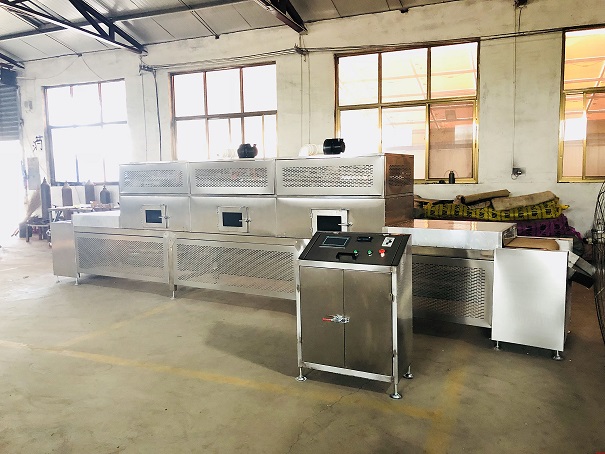
Tunnel type microwave drying equipment
Tunnel type microwave drying equipment is an industrial device that uses microwave energy to achieve rapid and uniform drying of materials, and is widely used in multiple industries.
Product details
Application areas and core uses of tunnel type microwave drying equipment
Tunnel type microwave drying equipment is an industrial device that uses microwave energy to achieve rapid and uniform drying of materials, and is widely used in multiple industries.
Technical advantages and working characteristics of tunnel type microwave drying equipment
- Efficient and fast drying: By directly applying microwave energy to the water molecules inside the material, they generate heat through intense friction, achieving uniform heating from the inside out. The drying speed is significantly faster than traditional hot air or sun drying methods. For example, the drying of yellow mealworms can be completed within a few minutes, greatly improving the efficiency of wood drying compared to traditional methods.
- Precise intelligent control: Adopting PLC intelligent control system, temperature, humidity and other parameters can be accurately adjusted to ensure stable and uniform drying process. Cooperate with the touch screen operation interface, support automated production, reduce manual errors, and improve product consistency.
- Energy saving, environmentally friendly, and pollution-free: using electricity as energy, no need to burn fossil fuels, and no exhaust gas, wastewater, or waste residue emissions during the drying process, meeting environmental protection requirements. Meanwhile, microwave energy utilization is high and consumes less energy compared to traditional methods.
- Improving product quality: Uniform heating to avoid surface hardening or internal dryness of materials, such as wood drying to maintain shape and size stability, yellow mealworm drying to retain nutrients and maintain complete color, reducing quality problems such as cracking and deformation.
Typical specifications and structural characteristics of tunnel type microwave drying equipment
Parameter Items 60KW model example specifications
Customized Processing Yes
Brand/Model; Ruisen En/60KW
Category Tunnel type microwave dryer
Heat transfer area; 12.5 m²
Speed 0-8 r/min
Power 60 kw
External dimensions; 13× 1.4× 2 m
Floor Area; 18 m²
Weight 2100 kg
Control method; PLC
Material Stainless steel
The equipment adopts a tunnel type continuous conveying structure, and the material passes through the microwave heating chamber at a constant speed through the conveyor belt, achieving continuous production. Stainless steel material enhances equipment durability, compact design saves production space, and is suitable for large-scale industrial scenarios.
Applicable scenarios and selection suggestions for tunnel type microwave drying equipment
- Large scale continuous production scenarios, such as wood processing plants, yellow mealworm breeding bases, building materials production enterprises, etc., prioritize the use of tunnel type equipment, whose continuous processing capacity can meet high-yield demand and improve overall production efficiency.
- In fields with high requirements for drying quality, such as precision wood processing, food and insect deep processing, the uniform heating and intelligent temperature control characteristics are utilized to ensure stable product quality.
- Small scale or intermittent production: Comparable to cabinet microwave equipment, the latter has a compact structure and flexible operation, making it more suitable for scenarios such as laboratories and small processing plants. When selecting, it is necessary to comprehensively consider material characteristics, production capacity requirements, and cost control, and prioritize uating the drying efficiency, energy consumption, and automation level of the equipment.
Tags:
Microwave High Temperature OvenContinuous tunnel high-temperature sintering furnaHigh temperature push plate kilnRoller kiln | Microwave roller kilnMicrowave high temperature furnace | Muffle furnacHigh temperature tower vertical kilnHigh temperature mesh belt sintering kilnHigh-temperature shuttle bell kilnHigh-temperature quartz tube furnaceHigh-temperature microwave rotary kilnHigh-temperature crucible and saggerAir source heat pump drying and dehumidifying machHigh-temperature insulation refractory material